Warp engaged

Hello, guest!

AlexandruValentinFlorea

AI engineer in training. I build vision and language models, then take them outside: onto satellite imagery, seven languages of hate speech, and a robot rolling down a railway track.

See the projects
Stage 01

About me

Portrait of Alexandru-Valentin Florea

I'm a master's student in Data Science and AI Technology at TU Delft, following the Visual Computing and Language and Speech Technology themes.

My bachelor's is in Computer Science from Vrije Universiteit Amsterdam, where I also completed the Honours Programme and a minor in Business Analytics and Data Science. My bachelor's thesis became a paper that I presented in London and that Springer Nature published in 2026, with me as first author.

What I like most is the part of machine learning where a model meets messy reality: thin contrails hiding among cirrus clouds, implicit hate that no keyword catches, a webcam bolted to a vibrating trolley. I want to work on technical AI in industry, and one day build a company around it.

Away from the keyboard my two big passions are aviation and cars, racing above all. Both reward the same things I like in engineering: tight margins, good telemetry, and people who obsess over the last tenth. In 2020 I picked up a DSLR and ended up trackside as photographer for Junior Motorsport at three rounds of the Romanian national championship.

StudiesMSc DSAIT, TU Delft, since Sept 2025. Day to day: Python and PyTorch, on vision and language models.
DegreeBSc Computer Science, Honours, VU Amsterdam, 2022 to 2025. 30 EC on top of the standard programme.
SpeaksRomanian natively, English at Cambridge C2 (and TOEFL iBT C1), Dutch at A2 and climbing.
Stage 02

The run so far

Drag the timeline, or use←→on the d-pad
Stage 03

Academics

Delft University of Technology

MSc Data Science and Artificial Intelligence Technology
Sept 2025 – now In progress

Where I am now, and where almost everything in the Projects section comes from. The programme is built around doing: nearly every course ends in a model you train, measure and defend. I chose two themes, Visual Computing and Language and Speech Technology, so my work sits on both sides of modern AI: pixels and words.

Visual computing

Computer Vision, 3D Visual Computing (camera geometry, stereo, NeRF, Gaussian splatting), and the Computer Graphics and Visualisation seminar.

Language and speech

Natural Language Processing, NLP for Society, and automatic speech recognition with Whisper.

Core

Machine and Deep Learning, in Python and PyTorch throughout.

In the field

The Joint Interdisciplinary Project, where a mixed engineering team builds for a real company. Mine was the YARC rail-inspection robot.
Vrije Universiteit Amsterdam

BSc Computer Science, with HonoursMinor: Business Analytics and Data Science
Sept 2022 – Aug 2025
8.5thesis
7.8degree
average
8.2honours
programme

A broad computer science degree that tilted more and more toward data and machine learning as it went on. It ended with the thesis “Understanding Body Dysmorphic Disorder Through Dynamic Network Simulation and Roleplay-Based Visualization”, which later became my first published paper.

From my second year (2023) I also followed the Honours Programme: 30 EC of extra courses spread over the last two years, on top of the regular 180. In 2024–25 I sat on the Commercial Committee of the Extensus Honours Association.

Where it was heading

Statistical Methods, Information Retrieval, Project Big Data, Pervasive Computing (ending in a deep-learning project), and the Business Analytics and Data Science minor.

The base underneath

Programming in C++ and Java, data structures and algorithms, computer organisation (x86 assembly), computer networks, web technology, software design. Good grounding; not what I do day to day now.

PackBot · 2023A Lego EV3 delivery robot (team of 3, MATLAB) that reads the number on a package with a camera, follows the matching colour-coded route and comes back for the next one. I trained the digit-recognition network and built its image pipeline.
IJVM emulator · 2023A small virtual machine written in C for the Computer Programming Project. My first larger codebase.
Dutch flashcards · 2024A JavaFX language-learning app (team of 4) with audio fill-in-the-word and multi-gap modes, JSON import/export, and a “fun mode” of Dutch cultural trivia that I led.
Project Big Data · 2024Classification and clustering over an 800,000-row dataset with Pandas (team of 4), ending in a report with data-driven recommendations.

Colegiul Național „Mihai Viteazul”, Bucharest

Romanian Baccalaureate, Mathematics and Computer Science

Sept 2018 – Jun 2022

Graduated with 9.40 / 10 from one of Romania's top high schools. Also earned the national informatics certificate (Atestat), the ECDL, Cambridge C2 and TOEFL iBT C1 in English.

Stage 04

Work

Yokoy

Working student, Data Science departmentYokoy Group AG, now Perk
Jul 2023 – Jan 2025
  • Maintained and extended the regex-based extraction configurations for Yokoy's production OCR invoice-processing system, capturing line items, pricing and other key fields from client invoices.
  • Diagnosed invoices that failed extraction and wrote targeted configurations to fix them, across dozens of supplier invoice formats.
  • Validated extracted pricing and line-item data with regular expressions before it entered the invoice management platform.
  • Handled confidential client financial data under GDPR and client data-protection requirements.
Stage 05

Projects

Five builds from the last year, newest first, then a few smaller ones from the lab notebook.

Robotics · Vision

YARC: camera perception for a rail-inspection robot

YARC is a start-up building a trolley that rides the rails and inspects them. In a five-person interdisciplinary TU Delft team I owned the camera perception subsystem: recording, dataset, detection models and the live system on the trolley.

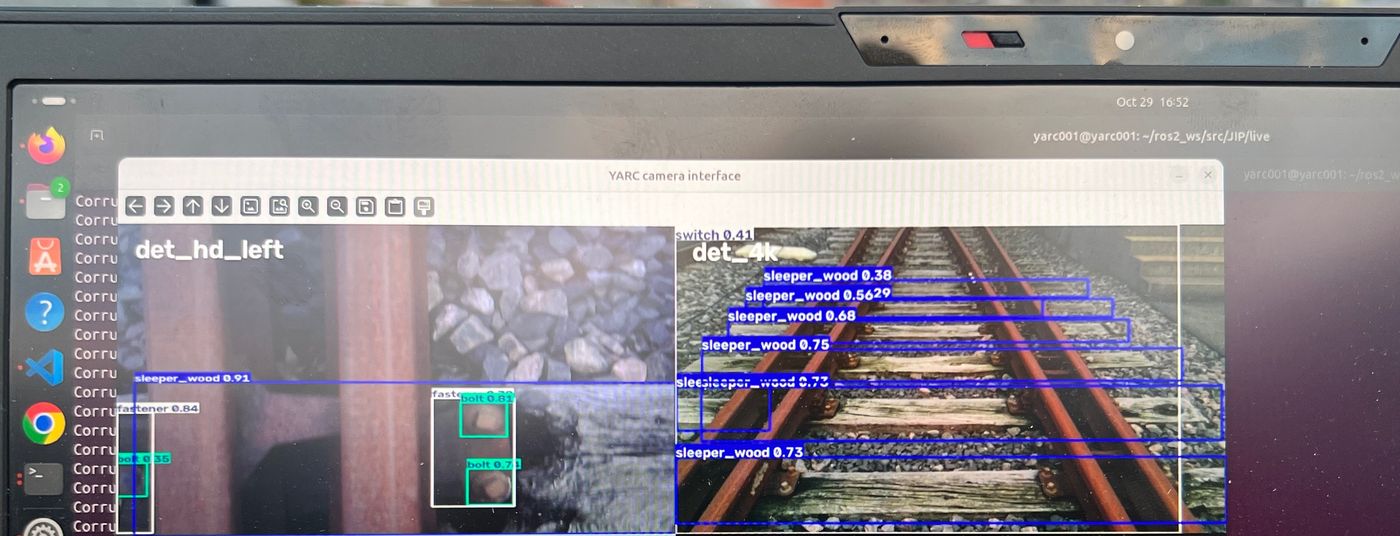
  • Three views, three detectors. A top-down HD camera over the rail finds sleepers, fasteners, bolts and clips (YOLO26n). A forward 4K camera reads sleepers and switches (YOLO26s). A 360° camera watches for people and vehicles (COCO-pretrained YOLO26n). The trained models are fine-tuned from COCO weights, because I had dozens of labelled frames, not thousands.
  • Detect components, infer defects. Real defects are too rare to train on. So the models find components and simple rules flag what is missing. One rule, run over 1,529 frames, turned a single known missing-bolt example into 11 more confirmed ones.
  • Recording pipeline on ROS 2. The stock camera driver recorded corrupt frames, so I wrote a node that passes the camera's MJPEG straight through into MCAP bags at about 30 Hz. Frames are then sampled by distance travelled, measured with phase correlation.
  • Evaluated on track it had never seen. The data is split by track, not by frame, so neighbouring frames cannot leak into the test.
  • Live on the trolley. One ROS 2 detector node per camera, always working on the newest frame. All three ran together during a two-day field test in October 2026.
0.986mAP50, HD model,
held-out track*
16recording runs
over 4 tracks
63 msper image on a
laptop CPU

*Common classes (sleepers, fasteners, bolts) on a small validation set; rare defect classes still need more data.

Full case study →YOLO26Transfer learningPyTorchROS 2OpenCVOpenVINOMCAP
Laptop on the trolley showing live detections: sleepers, fasteners and bolts boxed in the top-down and forward camera views
Live on the track, 29 Oct 2026: the top-down and forward detectors running side by side.
clip_displaced 4K forward: sleepers, switches · YOLO26s HD top-down: fasteners, bolts · YOLO26n 360°: people, vehicles · YOLO26n travel →
German0.60
Chinese0.45
English0.39
Arabic0.27
French0.23
Spanish0.23
Hindi0.09
F1 lost on implicit hate, per language (explicit minus implicit, fine-tuned XLM-RoBERTa, MultiHateCheck)
NLP

Multilingual hate speech detection

How much harder is implicit hate to catch than explicit hate, and does it depend on the language and the kind of model? In a team of four we built an end-to-end pipeline (a YAML-configured CLI for data preparation, synthetic data, training and evaluation). I owned the encoder: XLM-RoBERTa fine-tuned on a 28,970-sample corpus in 7 languages.

The encoder drops from 0.85 to 0.53 F1 on implicit hate (p < 0.001), worst in German. Few-shot Aya-23, Llama-3-8B and Mistral-7B showed a gap of at most 0.01 on the same benchmark, and adding explanations to the prompt barely helped.

0.32F1 gap,
encoder
≤ 0.01F1 gap,
few-shot LLMs
7languages
XLM-RoBERTaHugging FacePyTorchLLM evaluation
Illustration: contrails and predicted mask
Computer vision

Contrail segmentation from orbit

A PyTorch segmentation pipeline that finds climate-warming aircraft contrails in GOES-16 satellite imagery, where they are thin, rare and easy to confuse with cirrus. As an aviation fan, this one was personal. With a team of three I compared U-Net variants (ConvNeXt encoders, attention gates, lightweight maskers) against a 100:1 pixel imbalance.

0.704test Dice,
masked ResNet-152
2,400balanced
256×256 tiles
Team blog post ↗PyTorch LightningU-NetHydraW&B
stateslearningcontrol of learning
Research · Published

Simulating a disorder as an adaptive network

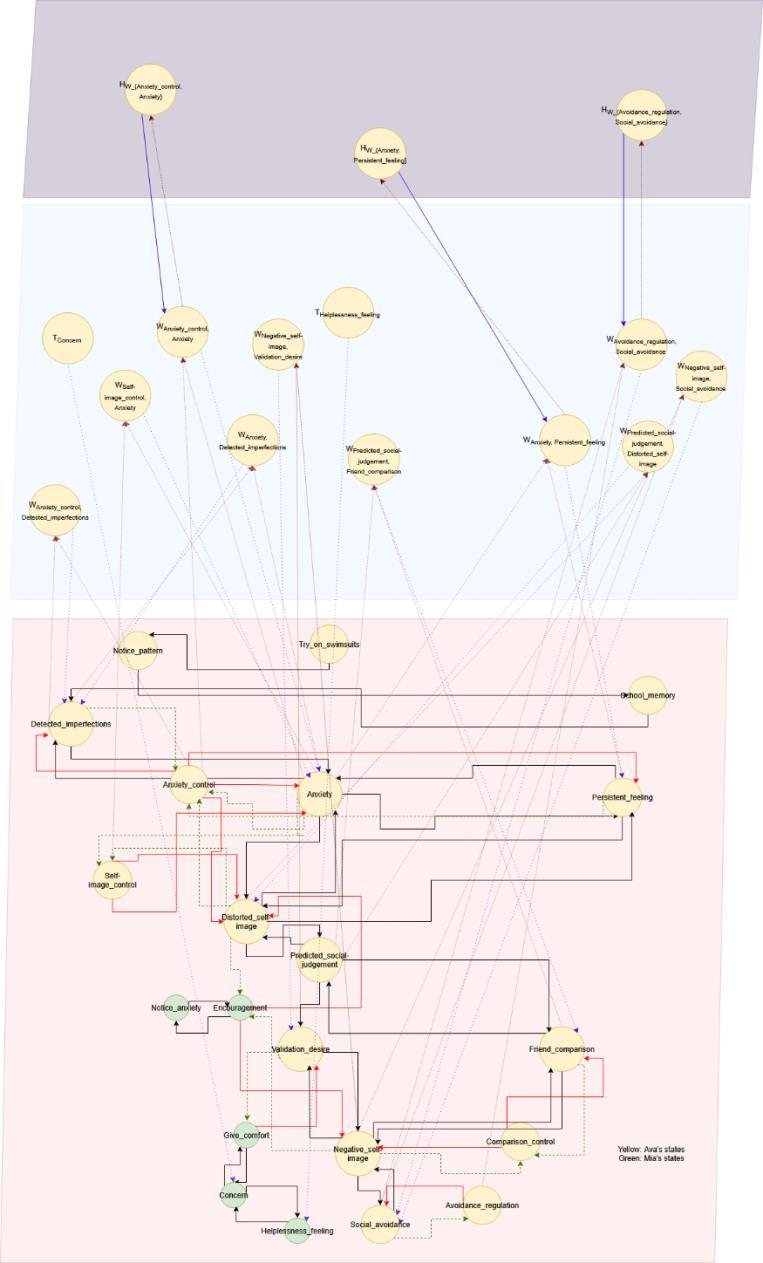
My bachelor's thesis at VU Amsterdam, now a paper: Understanding Body Dysmorphic Disorder Through Dynamic Network Simulation and Roleplay-Based Visualization. It models one episode in the life of a teenager, Ava, as a network of 37 states on three layers: mental states and behaviours, connections that strengthen with use (Hebbian learning), and a layer that controls how fast that learning happens.

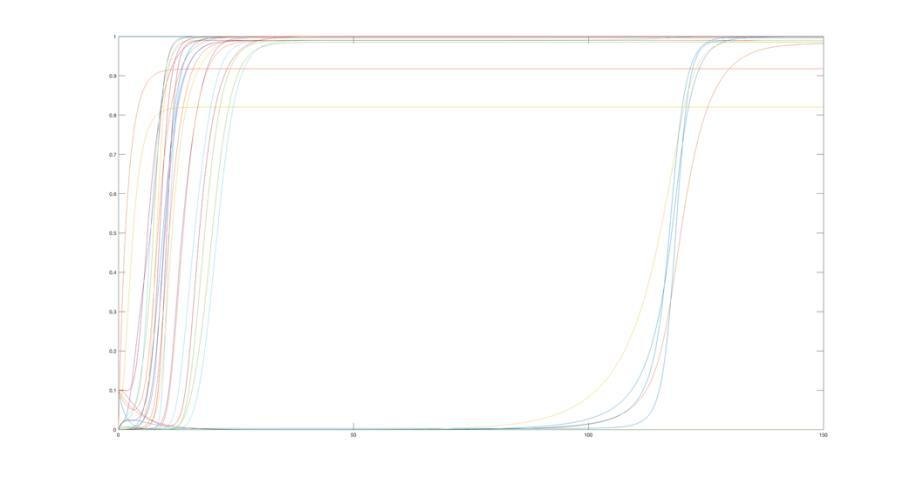
In simulation the symptoms escalate fast and almost in sync. Stronger self-control barely changes that, and a friend's well-meant reassurance ends up feeding the loop. I then retold the run as an AI-generated role-play video, so non-modellers can watch the cycle unfold.

Simulation plot: most symptom curves rise steeply to their maximum early on, a second cluster follows later
One run: most states hit the ceiling early, the friend's states follow later.
The full three-layer adaptive network model
The full three-layer model.

Presented at the Computing Conference 2026 in London and published by Springer Nature in Intelligent Computing, Volume 2. First author, with I.-D. Obada, R. M. Treur, S. C. F. Hendrikse and J. Treur.

Springer proceedings ↗Network-oriented modelling
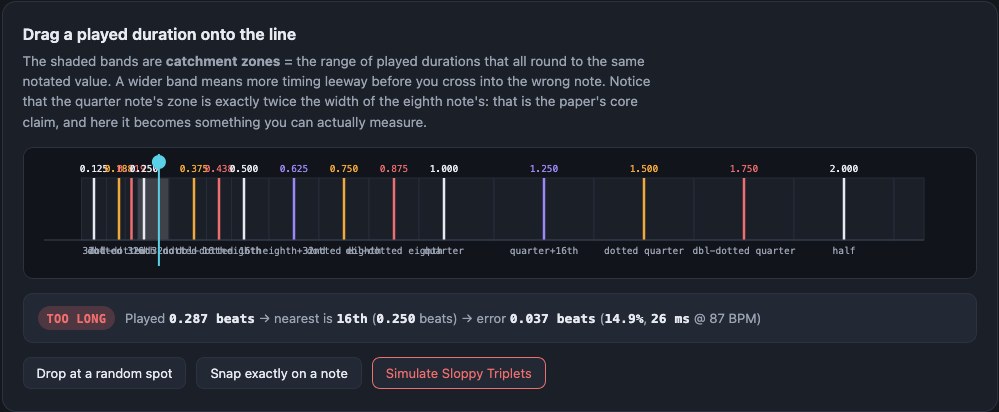
played timing → nearest representable duration
Visualisation

The Snap Line

An interactive explainer for TU Delft's Computer Graphics and Visualisation seminar, built on the paper Make the Unhearable Visible (Heyen, Gleicher and Sedlmair, IEEE TVCG). It lets you play with how a performance's raw note lengths get quantised into durations that sheet music can represent. I wrote the duration-quantisation model; the page is plain JavaScript and SVG.

Screenshot of The Snap Line: a played duration dragged along a line of representable note values, with its rounding error shown below
The live tool: drag a played duration and watch where it snaps.
JavaScriptSVGMusic visualisation
Instant-NGP from scratchNeRF with a multiresolution hash grid and trilinear interpolation, written from scratch in PyTorch for 3D Visual Computing.
Whisper on Dutch speechFine-tuning and augmenting Whisper for native and non-native Dutch speech, with paired bootstrap significance tests on the DelftBlue cluster.
RAG under attackWhat happens to multi-hop question answering when retrieval goes wrong? With perfect evidence the model reached 0.89 exact match; with real retrieval it topped out near 0.48, so retrieval, not reasoning, was the bottleneck. A little random noise did no harm; piling on look-alike wrong documents did. Code ↗
Adversarial examplesBlack-box hill climbing against white-box FGM and PGD attacks, compared on success and wall-clock cost.
Stage 06

Hackathons

One weekend · team of 4

XRP Ledger hackathon: paying people to flatten the peak

We built an app for energy companies to deal with demand spikes. When a spike is detected, the system signals users to cut back, checks who did, and rewards them in XRP tokens in proportion to how much they saved.

Python backend on the XRP Ledger, a front end for the users, and reward maths that had to add up to the last percent.

PythonXRP LedgerEnergy
grid thresholdspike without nudgesdemand after nudgesXRP rewardstime →
Stage 07

Ready, player two?

Internships, thesis ideas, start-up plans or a project that needs a model taken out of the notebook: write to me.